
A chance conversation led to the discovery of two natural seawater rock pools which we have not seen mentioned anywhere else.
Rinsey Head is a familiar landmark with its house apparently perched on the edge of the cliff. What many people miss is that there is a small cove at the base of the cliff – Porthcew – which has sand at low tide and has several tempting-looking rock pools.

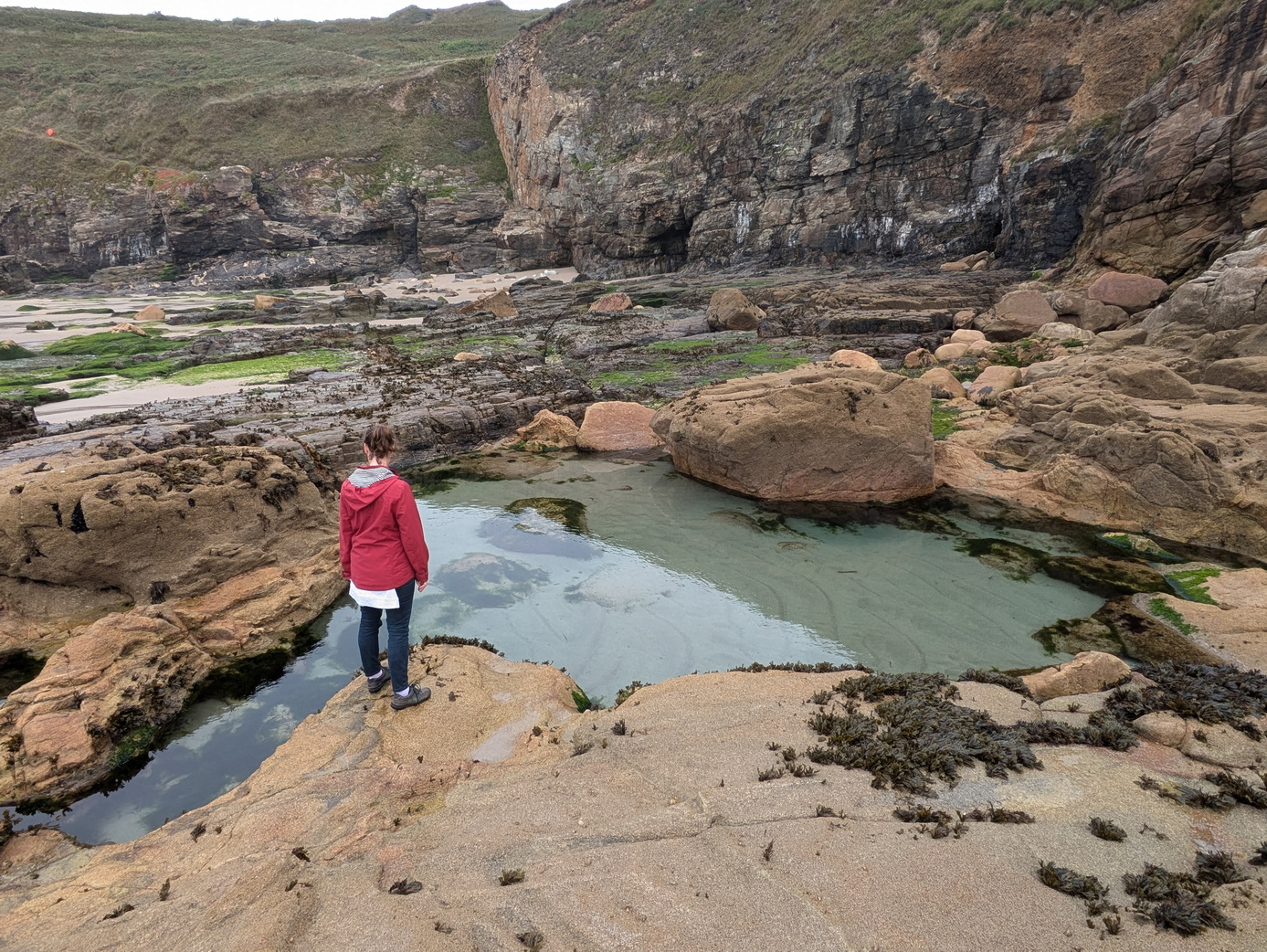
The main pools are on the east side of the beach with a largish one about six by four metres. You can find it here.

This pool is deep enough to immerse yourself with a shallow end of soft sand to amuse the shorter members of the party. Close by, there is a series of other smaller pools one of which has a natural arch for the courageous to swim through.

We had been told that the pool was next to a fishing rock and this did not appear to fit this description. Had the tide been lower, we could apparently have waded along the beach to another pool, further east but we took the high road, re-joining the coastal path.
Before leaving the beach we noted the very interesting geological transition from granite to sedimentary rock on the western side of the pool.

Despite commonly held beliefs, the coastline of Cornwall does not consist mostly of granite. In his excellent book The Granite Kingdom, Tim Hannigan says ‘… the only granite cliffs in Cornwall are to be found in the west: … a few small patches around Trewavas and Rinsey near Porthleven …’ This image shows the boundary between the granite on the right, carpeted in golden barnacles like a Laura Knight painting, and the sedimentary rock on the left. There is another transition on the other side of the cove.
Our resident mineral expert also noted a pegmatite vein running at right angles to the transition. We took his word for it.
Back on the coastal path, we walked towards Trewavas Head and, just before the chambered cairn, spotted a much larger rock pool with a slab of rock alongside which would be ideal for fishing.

This, surely was the pool we had been told about. The way down looked precipitous and, with a storm threatening, we were content to view from a distance. But it is large and looks deep enough for a good swim.

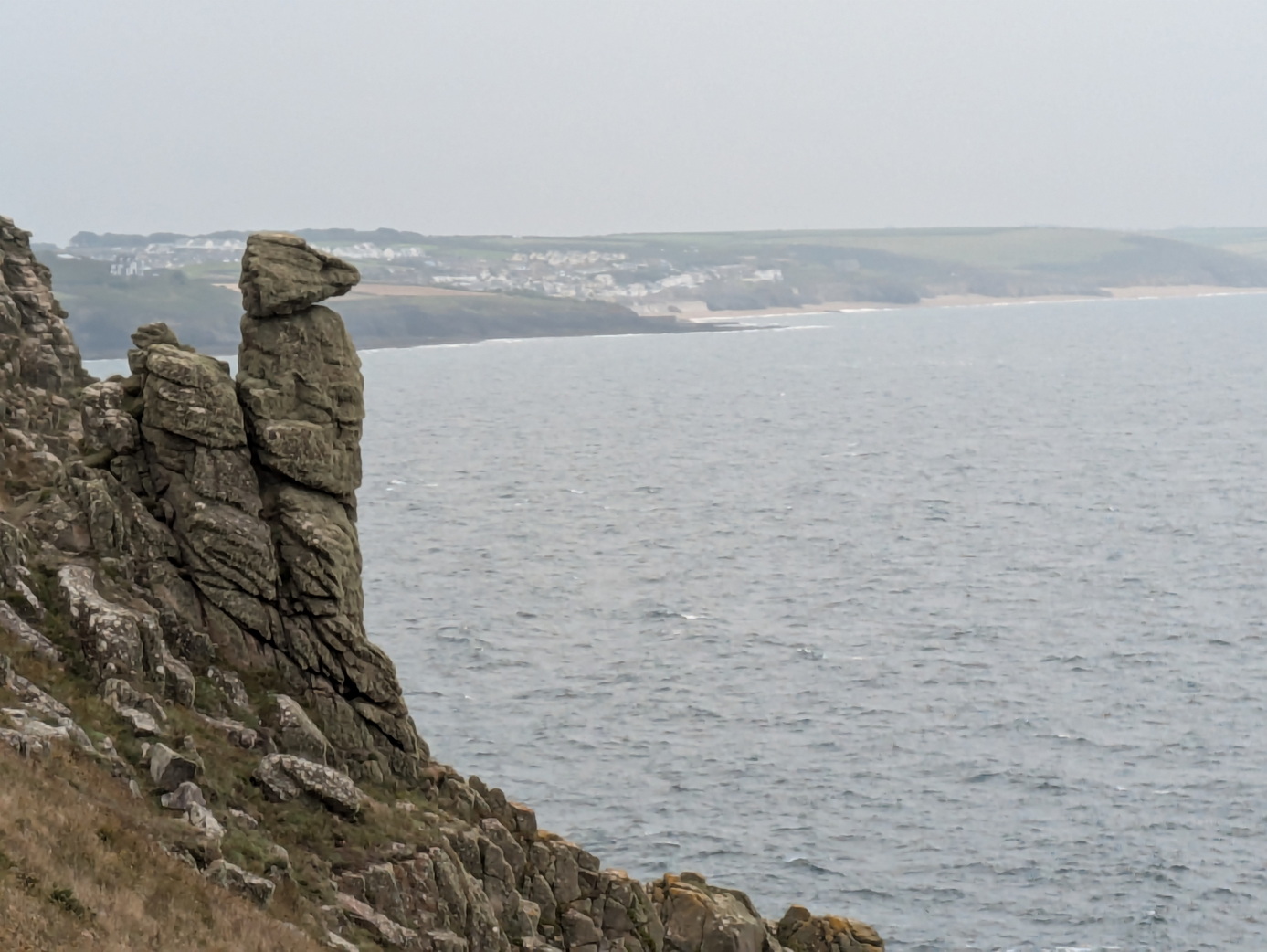
We could not leave the area without a visit to the chambered cairn and a look at the ‘camel’ stone just around the headland. We think it may be more of a meerkat than a camel but, either way, it is keeping a lookout at passing vessels.

 A Cornish Journey