Moreton Pound to Whitstone

p1070979
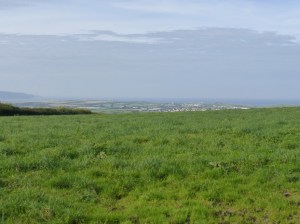
Looking west towards Bude

After a fabulous breakfast at a B&B in Bude (trying saying that out loud) we picked up where we had left off at Moreton Pound. Today would involve a long swing towards the sea to loop around the area around Bridgerule on the west bank of the river which should be Cornwall but is actually Devon. At Hackthorne near the wonderfully-named Budd’s Titson, the border is only about 3 miles from the sea.

This, coupled with the lack of north-south paths would drive us as far west as Marhamchurch. We had considered cutting off the bulge by walking the B3254 but one look at the road convinced us not to.
p1070980
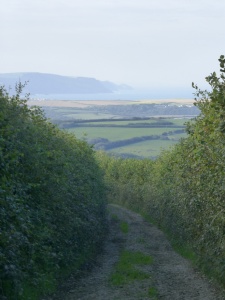
Looking south to Tintagel

The blackberries were no worse than the day before and we made good progress along lanes to West Leigh where we were to turn left onto the so-called Planekeepers’ Path. Here we hit a snag in the form of deep puddle of slurry completely blocking the track. Some lateral thinking took us through the farmyard of Leigh Farm walking past a ‘Private’ sign unnoticed, and back onto the track across the valley to Cross Lanes.

Leaving Cross Lanes, we had a view of the wonderful panorama of the coast, stretching from Tintagel to the domes of GCHQ north of Bude as we crossed open fields.

Two churches beckoned us on: Week St Mary on a hill far ahead and Stratton about a mile away to our right. This was a reminder of how prosperous or densely populated this area was in the C15 for seeing two or three church towers  at the same time is a rarity further west. We were headed for Launcells Church which was marked as being 600 yards away but was invisible. Stratton kept beckoning.
p1080007
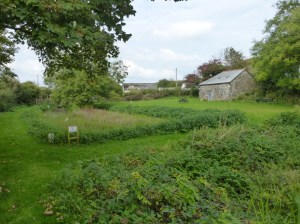
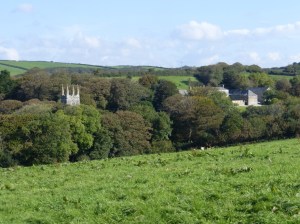
Launcells church and Barton

Then, quite suddenly, we were summoned by bells: Launcells was in the dell in front of us.

Fearful that a service was about to start (it was a Sunday), we hastened on to arrive at the door of the church at 5 minutes to 11. Thankfully the service was not due until quarter past and we were able to enjoy this glorious church which Simon Jenkins includes as *** in his book of Thousand Best Churches in England. It was well worth the effort as the church is lovely.

Alongside the church is Launcells Barton, a fine C18-fronted house which would suit George Warleggan’s aspirations.
p1080010
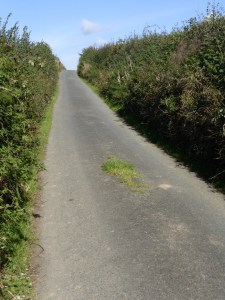
A typical road

Had we had confidence, we would have followed the Planekeepers’ Path from Launcells up to Hobbacott Down but our map did not show a connecting footpath and we opted for a road route to Lower Cann Orchard. Here we found the other end of the path from Hobbacott and so, if you try the route, have courage and take the path.

Our route now lay along a single rolling road through Budd’s Titson to Whitstone. It was another quiet road with tall hedges on either side. Something called Hooper’s rule dates hedges by the number of woody species in a thirty-yard distance with one species per 110 years. Dr Hooper clearly never lived in verdant Cornwall. Here it must be half that for the hedges were a riot of blackthorn, sycamore, oak, as well as the ubiquitous brambles.

Cornwall was experiencing its characteristic ‘second Spring’ for the campion was out in places, alongside garden-escapes of michaelmas daisies.

Hilton Wood closed in on us near the end of our walk: a tangled mass of ancient-looking forest, the rampart of a settlement or iron age castle peeking through the trees. Sadly some ‘leisure lodges’ could also be seen. Agricultural diversification has its price.
p1080014
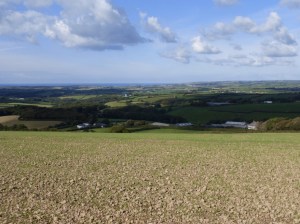
Looking seaward from Whitstone hill

All the streams we had seen so far had been flowing to our right, towards the sea, showing that we had not yet crossed the watershed into the Tamar valley which we probably left around West Leigh. The final steady climb of around 100m up to Whitstone convinced us that things were about to change.

Reaching the top, the views became better and better and there was a real feeling that we were climbing an escarpment. Sure enough, there ahead of us was the low valley of the Tamar while behind us stretched the coast from Tintagel to GCHQ. Our end-point had been well-chosen.

We had walked just over 9 miles in 3hrs 45 minutes and could have done more but Whitstone church awaited us. We had not seen the Tamar all day but we had walked around part of ‘Devon in Cornwall’ and crossed back into the Tamar valley.

Gooseham Mill to Moreton Pound

p1070941
Marsland Water

A bright October day took us back up to the furthest north of the duchy to start our serious attack on the Cornwall/Devon border and river Tamar walk. When we had reached the county border at Marsland Mouth on our coast path walk, we turned inland for a mile or so, ending in the nature reserve and wooded valley at Gooseham Mill. It was here that we started our walk, turning south for Plymouth.

The Marsland Water valley was lovely. On a narrow woodland path, we made our way along the Devon bank before crossing back into Cornwall and climbing up a hill towards Woolley where we joined a country lane. This led us across the busy A39 past a long barrow which is one of the few in Cornwall. This stands at a road junction, satisfyingly suggesting that one or more of the tracks must have an ancient origin.

p1070946
… or is this the source?

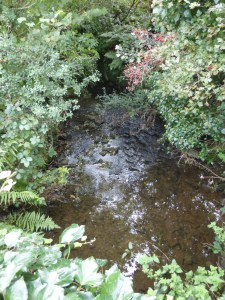
From here it was a short step to the source of the Tamar on Woolley Moor.  This must be the least sign-posted river source we have yet found (although the real source of the Nile is just as bad). A scrubby enclosure at the top of Woolley Wood was impenetrable unless armed with waders and several large brush-cutters. According to the map this contains ‘spr’. We had to be satisfied with some standing water which was a little way from the site of the ‘spr’ but which we took to be the beginning of the stream.

Crossing into Devon, we followed a country road to a junction where another stream crossed our path. Trentworthy Water looked rather larger than the meagre stream we had seen at the source and we momentarily questioned whether the geographers had got the right answer on the Tamar.

p1070948
Tamar at Youlstone Ham Bridge

A little way further on we were reassured for, as we crossed the Tamar at Youlstone Ham Bridge we could see that the river was now a respectable ‘small river’. We were back in Cornwall.

We were struck by the landscape of the area. We could not see or feel the sea: there was no soft salt-filled air to cool our cheeks. Around us was a landscape of low rolling hills dotted with green fields and small farmsteads. Fields contained cows or grass. The horizon was large with 360 degree views, dotted with wind turbines.

This felt very different from western, southern or coastal Cornwall. Walking was easy, though, with familiar country roads hedged with blackthorn, sycamore, holly and brambles. We did not want for sustenance for the blackberries were still around in abundance and we could snack as we walked along.

p1070950
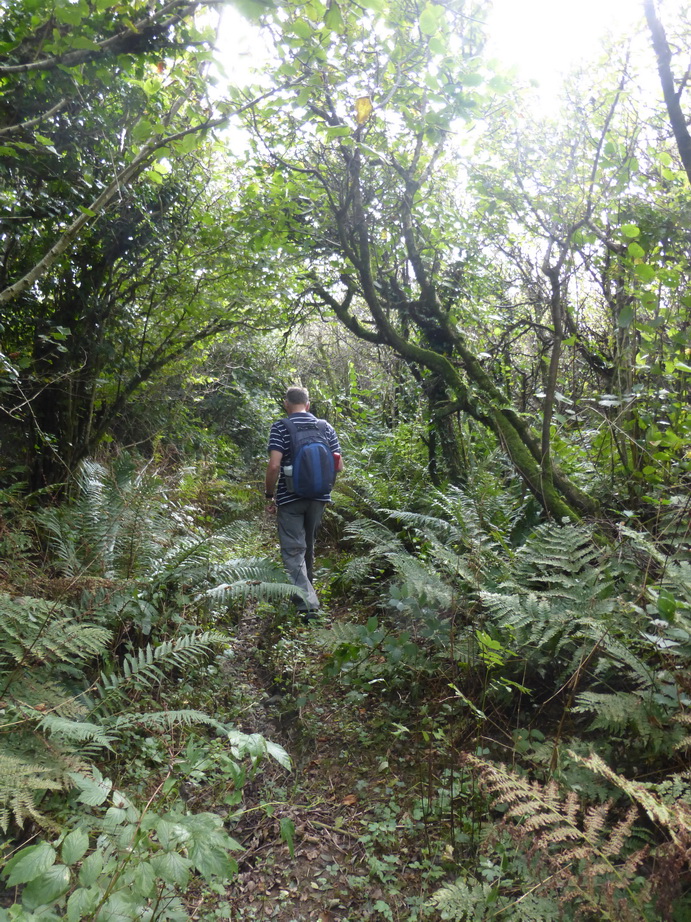
Deep in the undergrowth

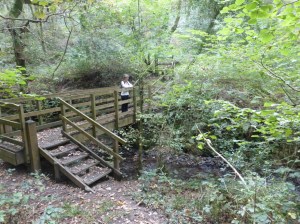
When I say ‘walking was easy’ this was only the general case. At one point our path deteriorated into one of those ancient paths so familiar from the wetter areas of Cornwall where you are not sure whether you are on a path or simply following the bed of a stream. Thankfully, the ground was moderately dry but the brambles and undergrowth more than made up for it. Machetes would have been helpful.

As we emerged from the covering of trees, we hoped for better but there was still a swampy patch to cross which would be distinctly unpleasant in wet weather, the rushes indicating that the water was not far below the surface.

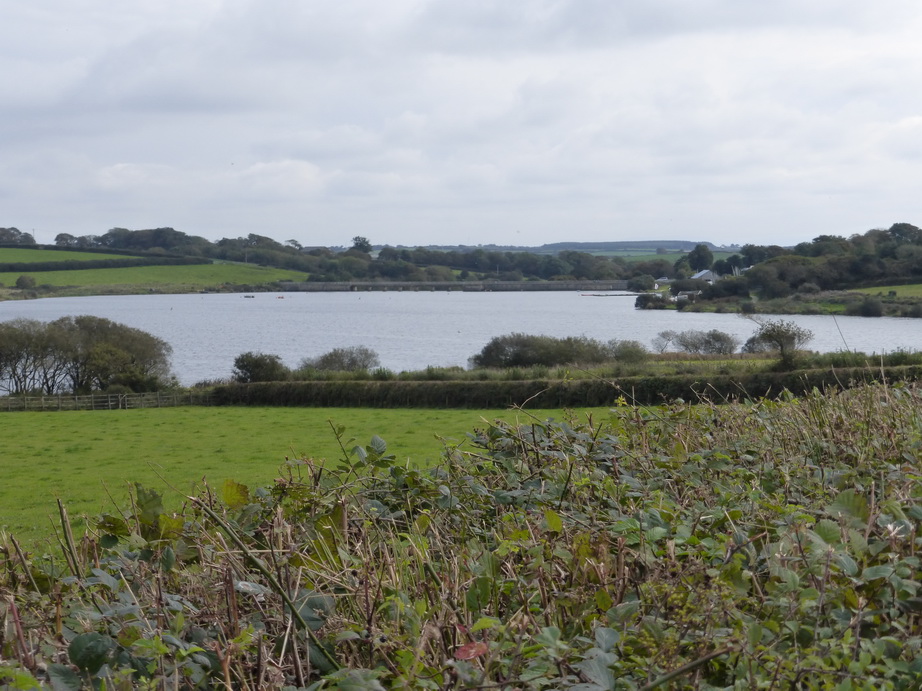
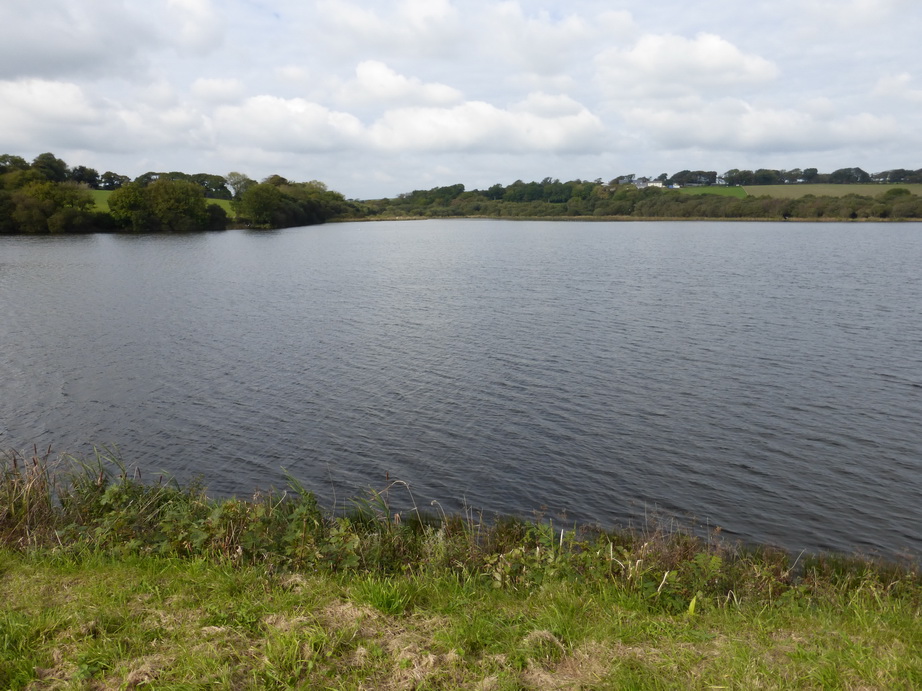
We approached the Upper Tamar Lake at a distance before making our way down to the junction with the Lower Lake which is a nature reserve and reservoir for drinking water. Here we found a convenient bench for our picnic, watching grebes and a cormorant diving for their lunches.

Bude aqueduct

Crossing into Devon at the dam, we followed the old Bude aqueduct for a delightful but sinuous walk  which reminded us of walking the levadas of Madeira except that the canal had long since ceased to flow and was being re-colonised by scrub. The ripples of the Tamar could be heard in the valley below us.

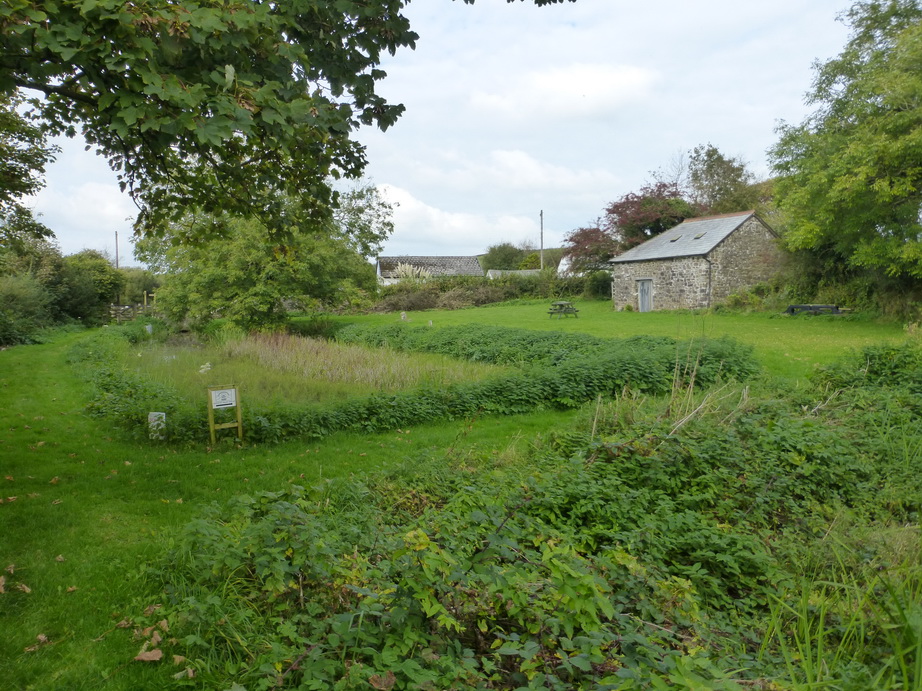
At Virworthy wharf we reached the head of navigation of the old canal. Here an exhibition in a small hut told the story of the C19 construction of the aqueduct. A series of short sections and inclined planes had allowed sand to be taken from Bude up into the hinterland to improve the drainage and acidity of the soils. It must have taken many, many loads to make much difference to a single field.

p1070956
Virworthy Wharf

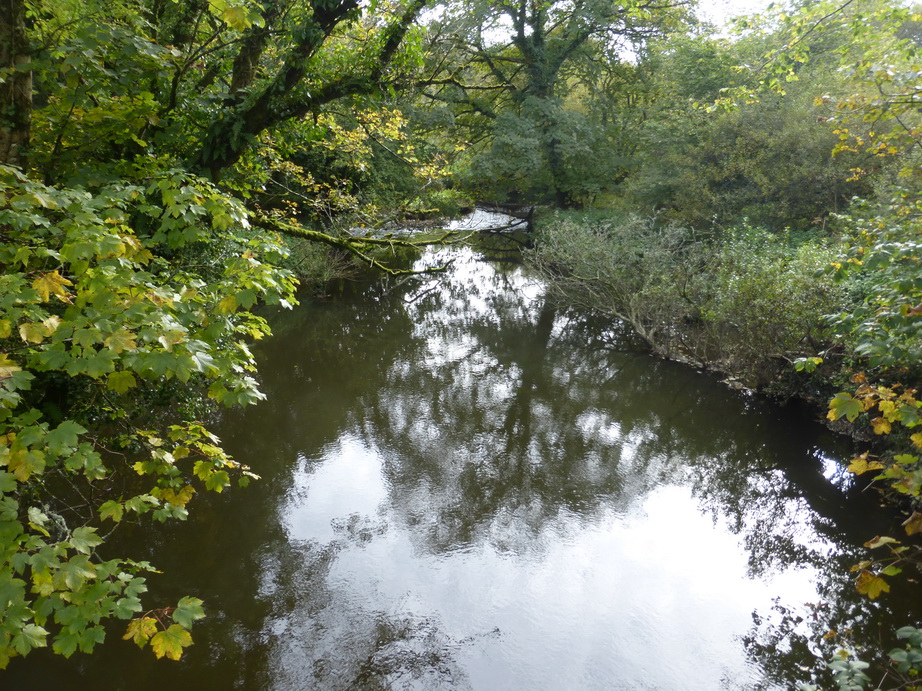
We had long given up trying to guess which direction in which we were walking when we found ourselves crossing a road near Puckland. We reluctantly left the canal/aqueduct and walked the short distance to Moreton Pound, crossing the Tamar back into Cornwall once again at Moreton Mill. By now she was a really respectable river and we itched to collect our canoes for the 100m length of decent water we could see.

We had walked 12 miles in just under five hours. It was strange to be back on roads and smooth paths without the ups and downs of coast path but it certainly made the going smoother.

The story continues …