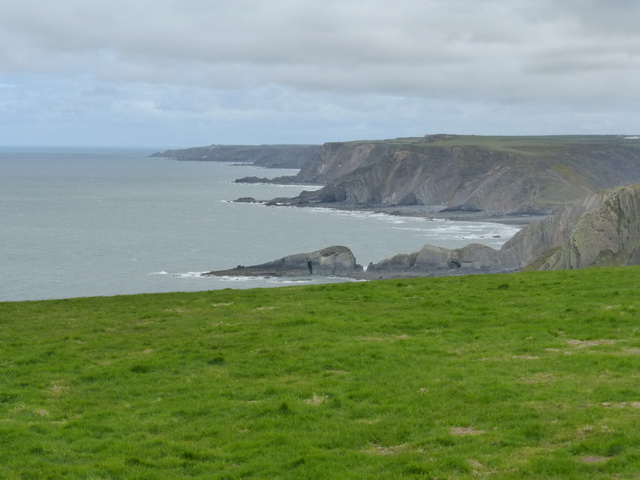
The last day of our walk around the Cornish Coastal Path threatened rain and, for the first time on our journey, we started out wearing cagoules.
Although what rain we did get was very light, the cagoules were good protection against the stiff wind. We had been promised 20-25mph winds (Force 5) but up on the cliffs it was more like a Force 6 and, if not a headwind, was generally a stiff beat to windward. Thankfully the wind was on-shore which was reassuring at times.

Leaving Bude was easy going over some rolling downland and we made good progress towards the first coombe at Sandymouth which has been colonised by a small NT (closed) cafe. On the horizon in front of us was the constant presence of the white domes of GCHQ. It was high tide and the rocky beaches were covered in breaking waves.
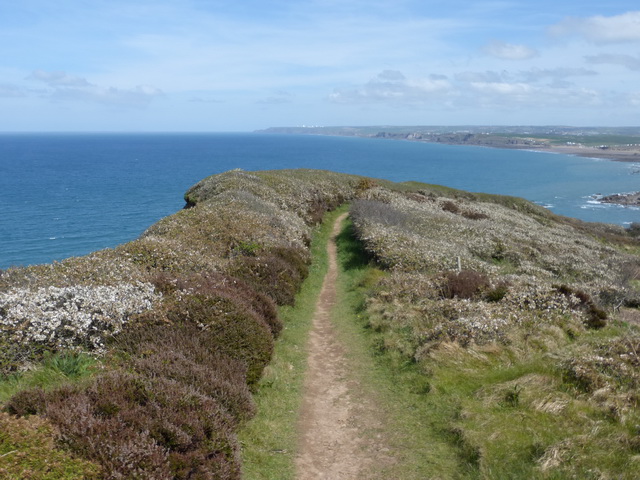
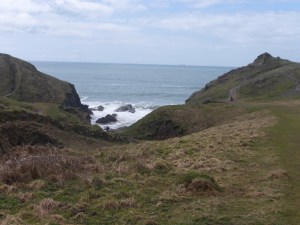
Sandymouth set the flavour of the day for it was a stiff descent and climb on the other side. From here to the border we encountered half a dozen such coombes, some of which had a shale path, some those irritatingly tall steps and some which had the decency to follow the contours on a long zig-zag. From Sandymouth, we noted Duckpool (Coombe), Stanbury Mouth, Tidna Shute, Litter mouth, Westcott and finally Cornakey (see chart below).

Only one of them was really lung-bursting in the manner of Beany cliff, leading you on to a false summit and then presenting you with as much again. We were thankful that we were not doing them at the height of summer and were even grateful for the cooling wind. Do not attempt this if you suffer vertigo, however, as you will find yourself apparently close to the edge at times.
The landscape changed accordingly, with the downs giving way to gorse and rough ground, apparently untouched by farming and tended by occasional horses or sheep.

GCHQ was well-protected, not only by wire and large signs warning ‘No photography’ and ‘This is a Prohibited Place’, but also by Coombes. Given the secrecy, we were amused later to see road signs to ‘GCHQ’.
We met few people, just a few individuals, and could enjoy the solitude and environment. The same flora as the previous day prevailed with the addition of what might have been a bee orchid and some candytuft.
We knew we were in for two extra delights on the walk: Hawker’s Hut and Morwenstow church. Had we been braver, we might have searched the cliffs for St Morwenna’s well.
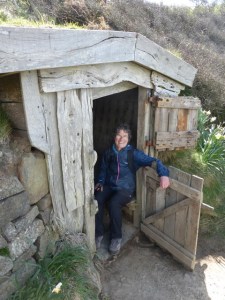
The story of the eccentric Robert Hawker is well known but there is still something wonderful about finding and sitting in his hut, preserved in its lonely location. Is it part of British eccentricity that a place like this can not only exist but survive and be preserved?
He is said to have written some of his poetry in his hut. Not having any with us, we had to think on him and could only declaim it on our return, chosen for its reference to spring and the violets that had accompanied us on the path.
We see them not – we cannot hear
The music of their wing –
Yet know we that they sojourn near,
The Angels of the spring!
They glide along this lovely ground
When the first violet grows;
Their graceful hands have just unbound
The zone of yonder rose.
I gather it for thy dear breast,
From stain and shadow free:
That which an Angel’s touch hath blest
Is meet, my love, for thee!
We found the grave slab of his wife Charlotte in Morwenstow church which is a couple of fields from the path. It is highly recommended for its Norman remains and a simply lovely ancient font.

The end felt within reach but there still three coombes lying in wait for us, thankfully not as testing as some of the earlier ones.
We reached the border after 8 miles (map) or 12 miles (gps) and four hours of walking. We had ‘gained’ 1915ft which explained why people found this a particularly tough section.
The border itself consisted of a small bridge with a dull post each side, one saying ‘Devon’ and the other ‘Cornwall’. Being more conscious of its image, Cornwall had also added a decent ‘Cornwall/Kernow sign’.
We celebrated with some lunch, avoiding pasties and cream teas for fear of having to decide whether we should be crimping them at the side or the top, and exactly where to put the cream and jam.
The ‘other place’ did not look that different from what we had been walking through.

This was, at the same time, the end of our adventure and the beginning of our next one for we ‘turned right’ and followed the tracks up the small valley and through a nature reserve to Gooseham Mill. We were heading for Plymouth and will be making our way across to the river Tamar and down its length to complete a circuit of Cornwall.




 Bynorth mouth looked nasty on the map but turned out to be a lovely wooded valley with the path following the slope up the valley through a small and primrose copse, before taking us across the stream and back up to the heights the other side. This was an exception for the path makers generally seem to prefer a direct down and up route. Zig-zags must be infra dig.




 A Cornish Journey