
Unlike the previous day, this proved to be very overcast: more grey cloud than the promised black cloud but with a biting east wind which kept us well-wrapped up when not walking.
We left Bossiney after a full breakfast which was designed to sustain us over a stretch that was known to be high, lonely and severe. People had asked us in cautious tones ‘have you done the Crackington stretch yet?’ Well, here we were.
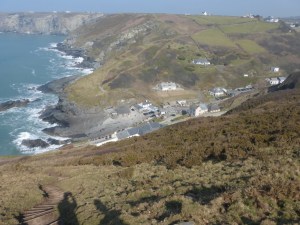
Rocky Valley was our first descent and it lived up to its name in the grey day with little green to relieve the textures. This was going to be a day of towering slate cliffs, the black-eyed caves sucking and blowing at the sea as the gentle rollers struck their base.

The going was relatively easy all the way to Boscastle with a white coastguard lookout beckoning us onwards. The water table had dropped sufficiently that the paths were not running streams and the patches of mud were not actually ankle-deep.
The Boscastle blow-hole was puffing its steam at the base of the cliff as the rollers ricocheted around the narrow twisting harbour.
As we had found the night before, all signs of the great flood of 2004 seemed to have disappeared and the haven was as charming and well-kempt as any other Cornish fishing village. The main village is tucked higher up, on a north-facing slope.
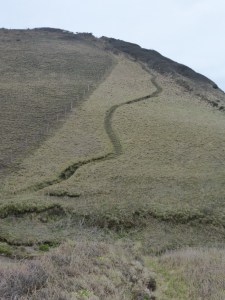
Walking onwards, we came to the first of the ‘challenging’ sections which was thankfully a steep descent and gentle ascent at Pentargon. Passing walkers said that we were definitely going the ‘wrong way’ today. We felt that we had been going the ‘right way’ the day before as the descents had been steep and the ascents largely gentle, much as we found at Pentargon.
Beeny cliff was the next objective and it soon corrected any optimism we might have had. The ascent to fire beacon point was up steep steps to what turned out to be a false summit with yet more twisting, turning and climbing in store. Lung-bursting indeed and time for a cup of coffee.
Beeny cliff is famous in poetry and we had brought a copy so that a recitation could take place.
 O the opal and the sapphire of that wandering western sea,
And the woman riding high above with bright hair flapping free –
The woman whom I loved so, and who loyally loved me.
The pale mews plained below us, and the waves seemed far away
In a nether sky, engrossed in saying their ceaseless babbling say,
As we laughed light-heartedly aloft on that clear-sunned March day.
A little cloud then cloaked us, and there flew an irised rain,
And the Atlantic dyed its levels with a dull misfeatured stain,
And then the sun burst out again, and purples prinked the main.
Still in all its chasmal beauty bulks old Beeny to the sky,
And shall she and I not go there once again now March is nigh,
And the sweet things said in that March say anew there by and by?
What if still in chasmal beauty looms that wild weird western shore,
The woman now is – elsewhere – whom the ambling pony bore,
And nor knows nor cares for Beeny, and will laugh there nevermore.
Thomas Hardy at his best, remembering his dead, estranged wife, Emma whom he first met at neighbouring St Juliot church where she was the Rector’s daughter. And it was March.

We knew there was more in store: not only did people tell us but we could see High Cliff in front of us, aptly named as it is the highest in Cornwall. What we did not expect was that the path would drop us down some way to make sure that we experienced the full delight of the climb. Step after torturous step took us up, and up until we emerged on the grassy top, definitely in need of a lie-down but constrained by the cold wind.
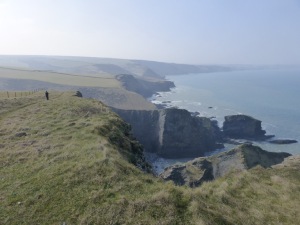
The views from its peak were spectacular stretching from Trevose Head, via Pentire and Tintagel, the whole flanked by the three major rocks which had been offshore: Meachard off Boscastle, Short Island and the Sisters off Tintagel. Ahead of us we could see beyond Cambeak to Hartland Point. On the hazy horizon, the bulk of Lundy was just discernible.

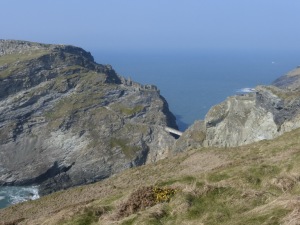
Below us, the cliff tumbled down, dark and impressive, to the sea far below. These were not the vertical cliffs of Port Isaac, nor the gorse-laden cliffs of Zennor. No sandy beach fringed their feet, just rough black and grey stones.
We could not linger and headed onwards, leaving our copy of the poem to some passing friends, enjoining them to pass it on again in an endless chain that it may be enjoyed on Beeny cliff for generations.
The path to Cambeak seemed straightforward after this and we felt that we were within easy reach of our goal. ‘Beware of goats’ said the guidebook and they were right for one small dip contained some black-coated goats with wonderful horns.
We had been struck by the lack of colour in the landscape, partially because of the grey day but the green of the fields and the yellow of the gorse were the only relieving colours to the mix of blacks and browns. No green shoots yet covered the blackthorn or sprouted from the bracken. In one sheltered corner, the primroses were bold enough to emerge.
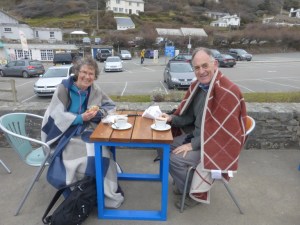
Rounding Cambeak and patting the head of the dragon, we dropped down into Crackington Haven and a welcoming hot cup of coffee and late lunch. We were joined by a very bold grey wagtail who must have felt that sandwiches were easier pickings than anything to be found in the stream.
We had covered about 9.7 miles in 4.25 hours and gained 1478ft. More importantly, we felt that we had laid the ghost of ‘Crackington Haven’ and could tackle ‘severe’ and survive to tell the tale. The end was literally in sight.
As light relief on the way home, we visited St Gennys and Forrabury (Boscastle) churches. A headstone in Forrabury seemed apt: You will find me on the cliffs and moors, on the rocks and on the mountains. Thank you Ron Hart d. 2008.




 A Cornish Journey